·
8 min
Contract Testing: Secure API Contracts Early and Safely

Roman Kirchmeier - Autemos

Contract testing checks each service in isolation to confirm that the messages it sends and receives conform to a shared contract, catching contract breaks in minutes rather than in production. A renamed field, a changed data type—and suddenly a service that ran fine for months breaks. In distributed architectures, these silent contract breaks between services are among the most common sources of failure. Instead of finding errors in a shared environment or in production, the approach shifts detection left—onto each team's own build stage. This guide explains what the approach is, which problem it solves, how it works technically, and why it matters so much for banks and regulated microservices.
TL;DR: Contract testing verifies each integration point in isolation against a shared contract, catching breaking changes in minutes rather than in production. Per Uptrends State of API Reliability 2025, API downtime rose 60 percent year over year—a strong case for catching contract breaks early and automatically.
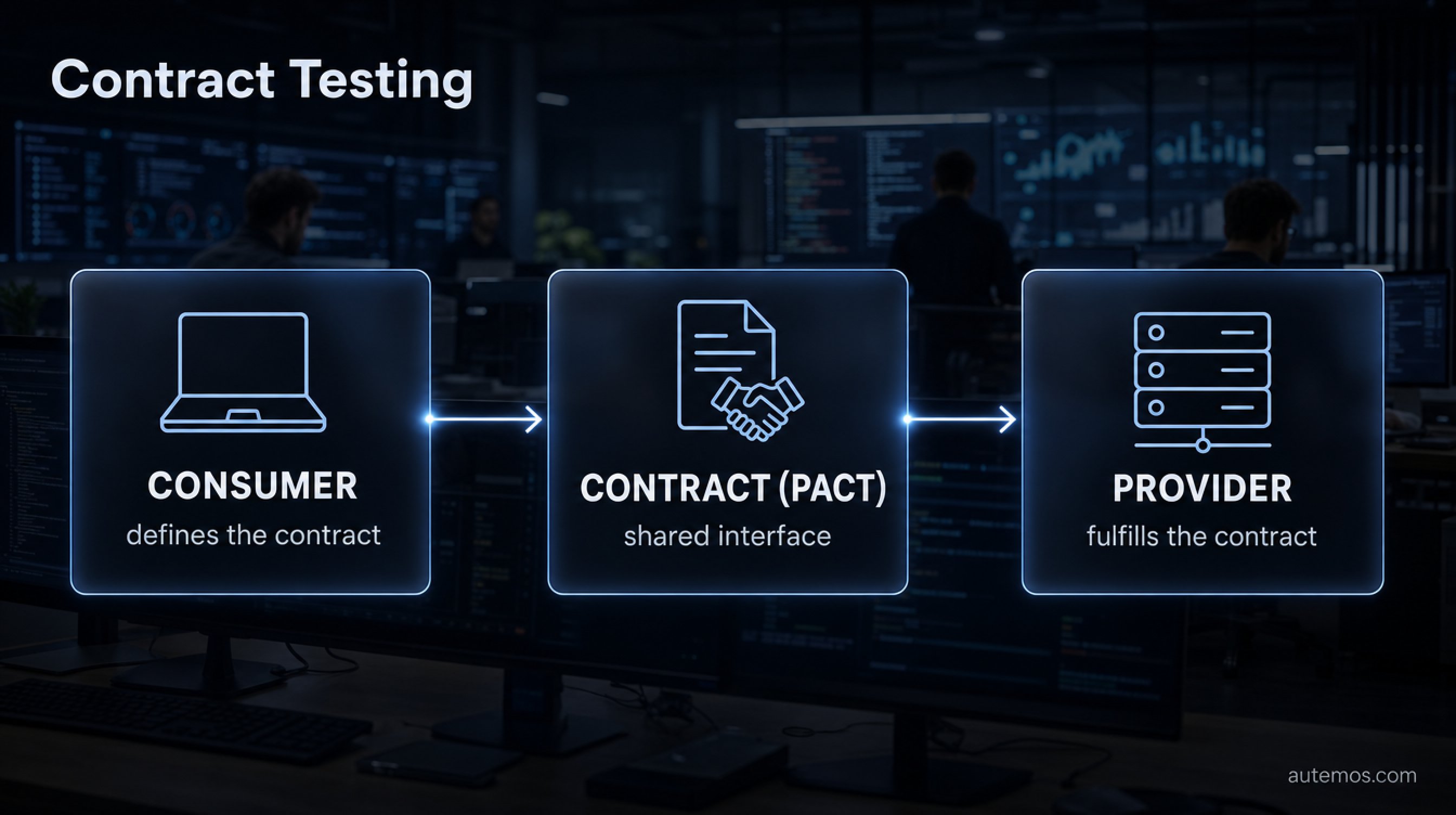
Figure 1: Consumer, contract (Pact) and provider – the core principle of contract testing.
What Is Contract Testing?
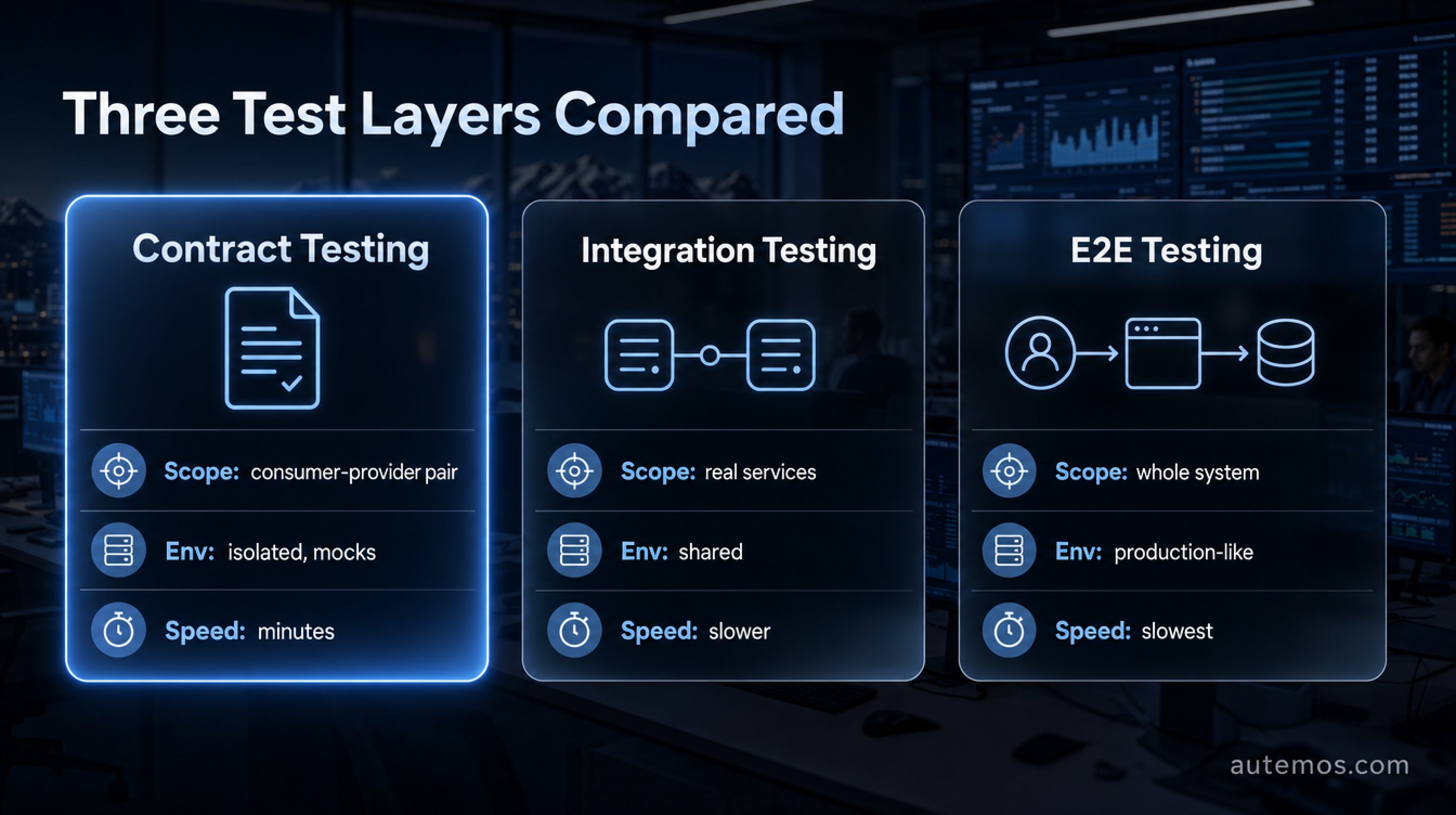
Figure 2: Contract testing, integration testing and E2E testing compared by scope, environment and speed.
Contract testing is a subtype of API testing that verifies an integration point by checking each application in isolation—without a shared environment. It confirms that exchanged messages conform to a shared contract. Per Pact Docs, mocks are enough for this; a run takes minutes, not hours.
The Pact Docs define the method this way: "Contract testing is a technique for testing an integration point by checking each application in isolation to ensure the messages it sends or receives conform to a shared understanding that is documented in a 'contract'." The contract is the shared reference point for both sides.
The most common variant is consumer-driven contract testing (CDC). Here, the consumer defines the contract the provider must satisfy. Only the parts the consumer actually uses get captured. That has a welcome consequence: provider behavior no consumer exercises can change freely, without breaking a test.
How Does It Differ From Integration and E2E Testing?
The difference lies in scope, environment, and speed. The approach looks at a single consumer-provider pair in isolation. Integration testing checks two or more real services in a shared environment. End-to-end testing runs the whole system in a production-like environment—thorough, but slow and brittle.
Dimension | Contract Testing | Integration Testing | E2E Testing |
|---|---|---|---|
Scope | One consumer↔provider pair, isolation (mocks) | Two or more real services | Whole system / journey |
Environment | None shared; CI & dev machines | One shared test env | Full production-like env |
Speed | Minutes | Slower | Slowest |
Catches | Breaking changes / schema drift | Real wiring/data errors | End-user flow failures |
Misses | Behavior no consumer exercises | Pairwise granularity | Which service broke |
Maintenance/cost | Low–medium (broker, versioning) | Medium–high (env) | High (brittle) |
Microservices fit | Independent deploys, fast detection | Verifying critical integrations | Thin top layer |
These three layers complement each other. For the broader picture, our overview of the main software testing types sets the context.
Which Problem Does Contract Testing Solve?
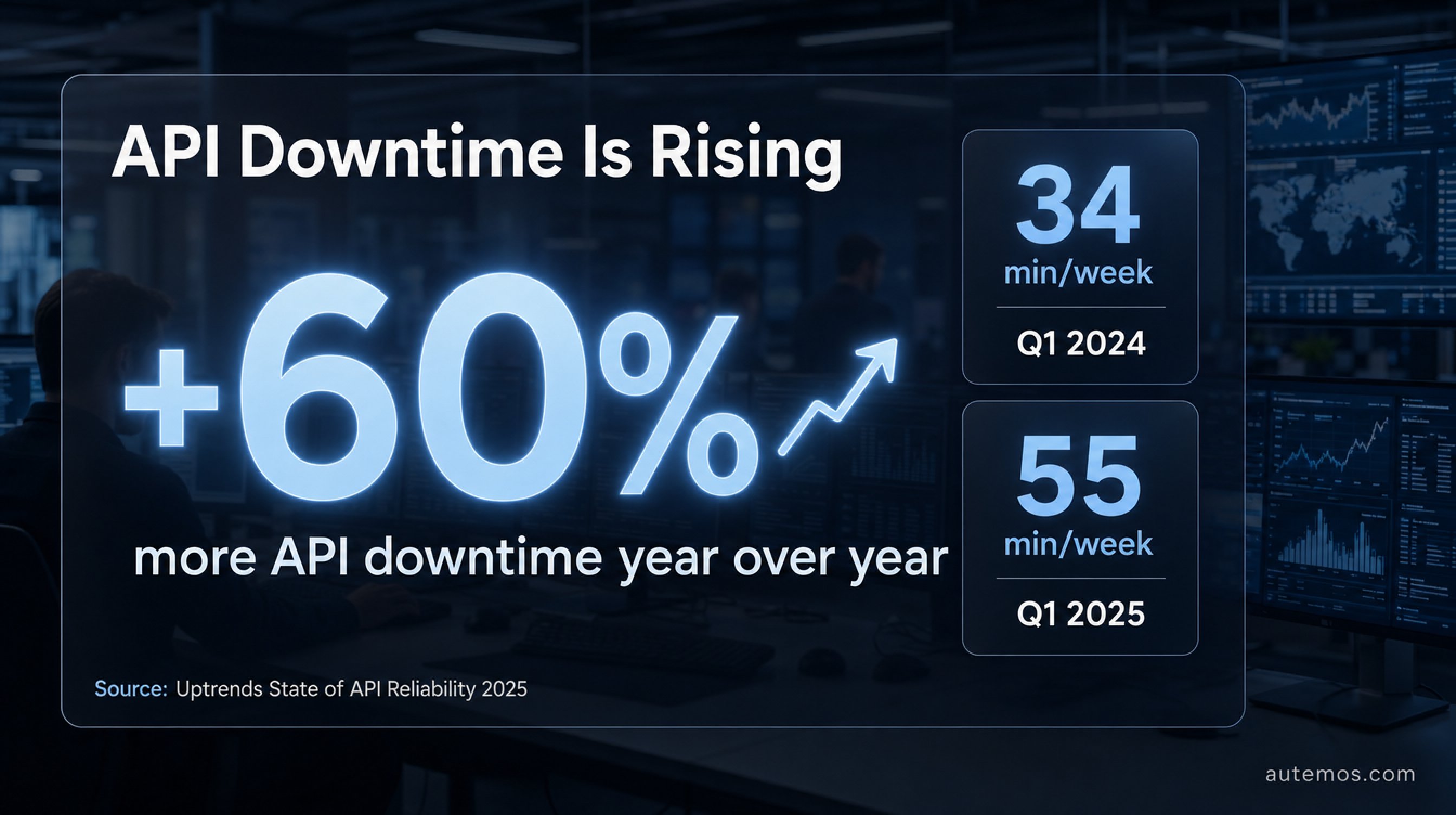
Figure 4: API downtime rose 60 percent year over year, from 34 to 55 minutes per week (Uptrends 2025).
Contract testing solves the problem of silent contract breaks in microservices—so-called schema drift. When a provider renames a field, changes a type, or drops one, consumers often break unnoticed. Data from the CNCF Annual Survey 2024 show that roughly 46 percent of organizations build or run microservices—every interface is a potential break point.
The more services deploy independently, the costlier late detection becomes. Catch a breaking change only in the shared environment, and several teams hunt for the cause together. Catch it in production, and the customer pays. The method moves that late detection forward.
The numbers underline the pressure. According to the Uptrends State of API Reliability 2025, average API availability fell from 99.66 percent (Q1 2024) to 99.46 percent (Q1 2025)—a 60 percent rise in downtime year over year, from 34 to 55 minutes per week. In client projects, we regularly see that a large share of these outages traces back to undetected interface changes, not infrastructure.
A contract is not a document someone maintains and then forgets. It is executable code that confirms, on every build, that consumer and provider still speak the same language.
How Does Contract Testing Work?
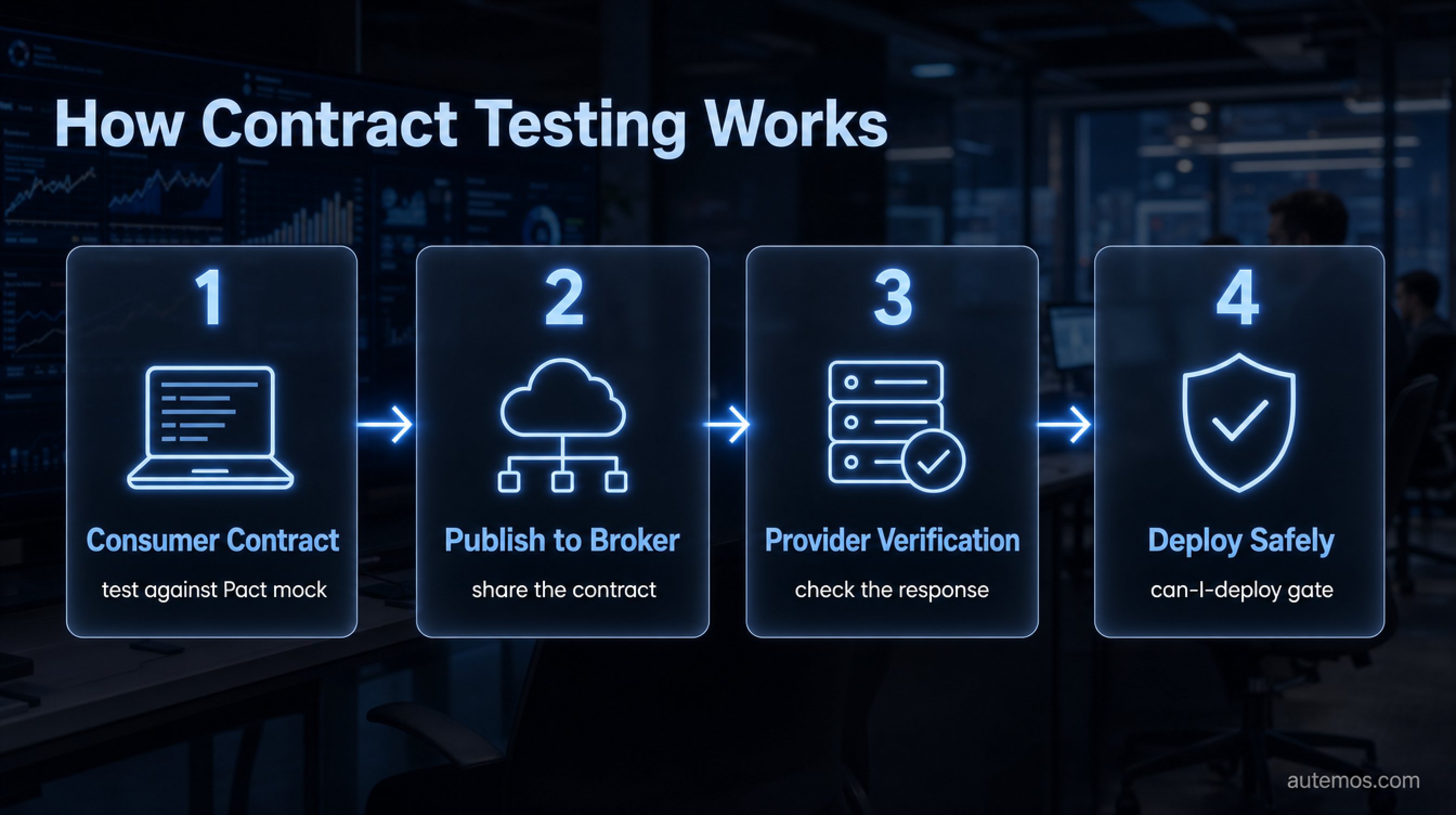
Figure 3: The four-step flow – from consumer contract through broker and provider verification to a safe deploy.
The process runs in four steps that Pact Docs describe as the standard flow. The consumer creates the contract, a broker shares it, the provider verifies it, and a gate decides on the deployment. The whole cycle fits into a CI pipeline and needs no shared environment.
From Consumer Contract to Safe Deploy
The four steps in detail:
Consumer contract: The consumer tests its behavior against a Pact mock. Each interaction gets recorded as a JSON contract.
Publish to broker: A Pact Broker shares contracts and verification results between teams.
Provider verification: The provider's build retrieves the contract, replays each request against the real provider, checks the response, and publishes the result back.
Deploy safely: Through the broker's "can-I-deploy" function, a service checks before release whether it stays compatible with all relevant counterparts.
Which Tools Are a Good Fit?
The tooling landscape is manageable. Pact is the de-facto standard for CDC, works across languages, and ships the infrastructure via Broker and PactFlow. Per the Pact Docs, "Pact is a code-first tool for testing HTTP and message integrations using contract tests." Spring Cloud Contract fits the JVM/Spring ecosystem and uses a Groovy/YAML DSL. Schemathesis generates property and fuzz tests straight from OpenAPI or GraphQL specifications. Postman also covers parts through collections, mocks, and OpenAPI validation; Specmatic, Karate, and Bruno round out the field.
Which tool fits depends on your stack. For REST interfaces, our guide on testing REST APIs with methods and tools is worth a read.
When Should You Use Contract Testing—and When Not?
The approach fits when multiple independently deployable services communicate over HTTP or event APIs and separate teams need fast feedback on breaking changes. But it is no silver bullet: per Pact Docs, it covers only the interactions a consumer actually exercises—everything else stays unchecked.
The honest benefits:
Early detection: Breaking changes surface at the service level in minutes, not in production.
Leaner E2E tests: The expensive E2E layer shrinks to genuine user journeys.
Easy debugging: The fault sits in the component under test; tests run on the dev machine.
The equally honest limits:
No replacement: The approach complements integration tests and end-to-end tests but does not replace them.
Limited coverage: Only interactions the consumer uses get verified.
Operational overhead: Broker, versioning, and discipline on both sides cost time.
It is a weak fit for a monolith or single-team setup, for few integration points, and for unstable, early APIs. Start there, and you invest effort in contracts that keep changing.
Why Does Contract Testing Matter for Regulated and Financial Microservices?
For banks and regulated providers, the approach delivers two things that carry real weight in the DACH region: safe releases and an audit trail. The broker's "can-I-deploy" function enables controlled, independent approvals—a direct counterpart to change management. Uptrends reports for 2025 that FinTechs resolve 85 percent of API incidents in under five minutes (Uptrends 2025); contract breaks caught early contribute to that.
The broker also acts as a versioned record of which consumer and provider versions are verified compatible. That is audit evidence in the literal sense: during a review, you can prove that a release ran against a verified contract. This very link between contract verification and change approval is missing from most German-language sources—a gap that regulated teams must close themselves.
In concrete terms: a silent schema change in a provider service can mean, in a financial setting, not just an outage but a deviation from the approved release configuration—and that is exactly what raises compliance concerns. Regulated release processes require every production change to be planned, reviewed, and approved in a traceable way. When a microservice drifts unnoticed from its contract, an unplanned change appears that no change ticket covers. The broker exposes that gap before it reaches production: the "can-I-deploy" query can be wired into the release workflow as a technical approval gate, and the verified contract result serves as evidence for the release decision.
The cost of failure is high in financial services. Industry estimates put large-enterprise downtime costs in the millions per year. In our projects with regulated teams, though, the problem is less the single minute of downtime than the question of how a change reached production at all. Against that backdrop, an automated safety net for interfaces is less a nice-to-have than a requirement—it delivers technical stability and audit-ready evidence at the same time. For how such checks fit into a broader test stack, see our complete guide to API testing.
Frequently Asked Questions About Contract Testing
What is the difference between contract testing and integration testing?
The approach checks a consumer-provider pair in isolation with mocks and no shared environment; a run takes minutes. Integration testing checks two or more real services in a shared environment. Per Pact Docs, the approach catches breaking changes earlier but does not replace verifying real wiring.
What is consumer-driven contract testing (CDC)?
In CDC, the consumer defines the contract the provider must satisfy. Only the parts of the interface actually used get captured. Per Pact Docs, provider behavior no consumer exercises can then change freely—a practical advantage for teams that work independently.
Does contract testing replace end-to-end testing?
No. The approach complements E2E testing but does not replace it. It shrinks the expensive E2E layer to genuine user journeys, while contract breaks surface at the service level. Per Pact Docs, the method covers only interactions a consumer uses—whole journeys remain the job of the E2E layer.
Which tools are suited to contract testing?
Pact is the de-facto standard for consumer-driven contracts and ships infrastructure via Broker and PactFlow. Spring Cloud Contract fits JVM environments, and Schemathesis generates tests from OpenAPI or GraphQL specifications. Postman, Specmatic, Karate, and Bruno also cover parts. The choice depends on your technology stack.
When should you not use contract testing?
For a monolith or single-team setup, for few integration points, or for unstable, early APIs, the effort rarely pays off. Contracts would need constant updating. The method delivers value once multiple teams deploy independently and interfaces are stable enough for reliable contracts.
Conclusion
Contract testing closes an expensive gap between fast unit tests and slow end-to-end tests. It catches breaking changes at the service level in minutes, enables independent releases, and provides a verifiable record of compatible versions through the broker. For regulated microservices in the DACH region, the approach joins two worlds rarely considered together: technical safety and audit-ready change management. No silver bullet, but a precise tool for clearly defined problems. The key is to apply it where independent teams share stable interfaces—and not to confuse it with integration or E2E testing. If you want to explore how the method fits automatically into your pipeline, book a demo with our team.