·
8 min
Regression Testing: Definition, Process & Automation

Roman Kirchmeier - Autemos

Regression testing verifies that areas which already worked still work correctly after a software change. Every change—a bug fix, a new feature, a refactor—can break something in an unexpected place, and that is exactly where regression testing comes in. According to the State of Quality 2025, around 45% of QA teams automate regression tests before any other test type (Katalon, 2025). This article covers the definition, triggers, process and types—and shows why automation with self-healing mechanisms offers the biggest lever for DACH enterprises and banks.
In brief: A regression test checks, after every change, whether previously working software still behaves correctly. It is the most-automated test type—around 45% of teams start here (Katalon, 2025). Self-healing locators cut the costly maintenance of unstable tests.
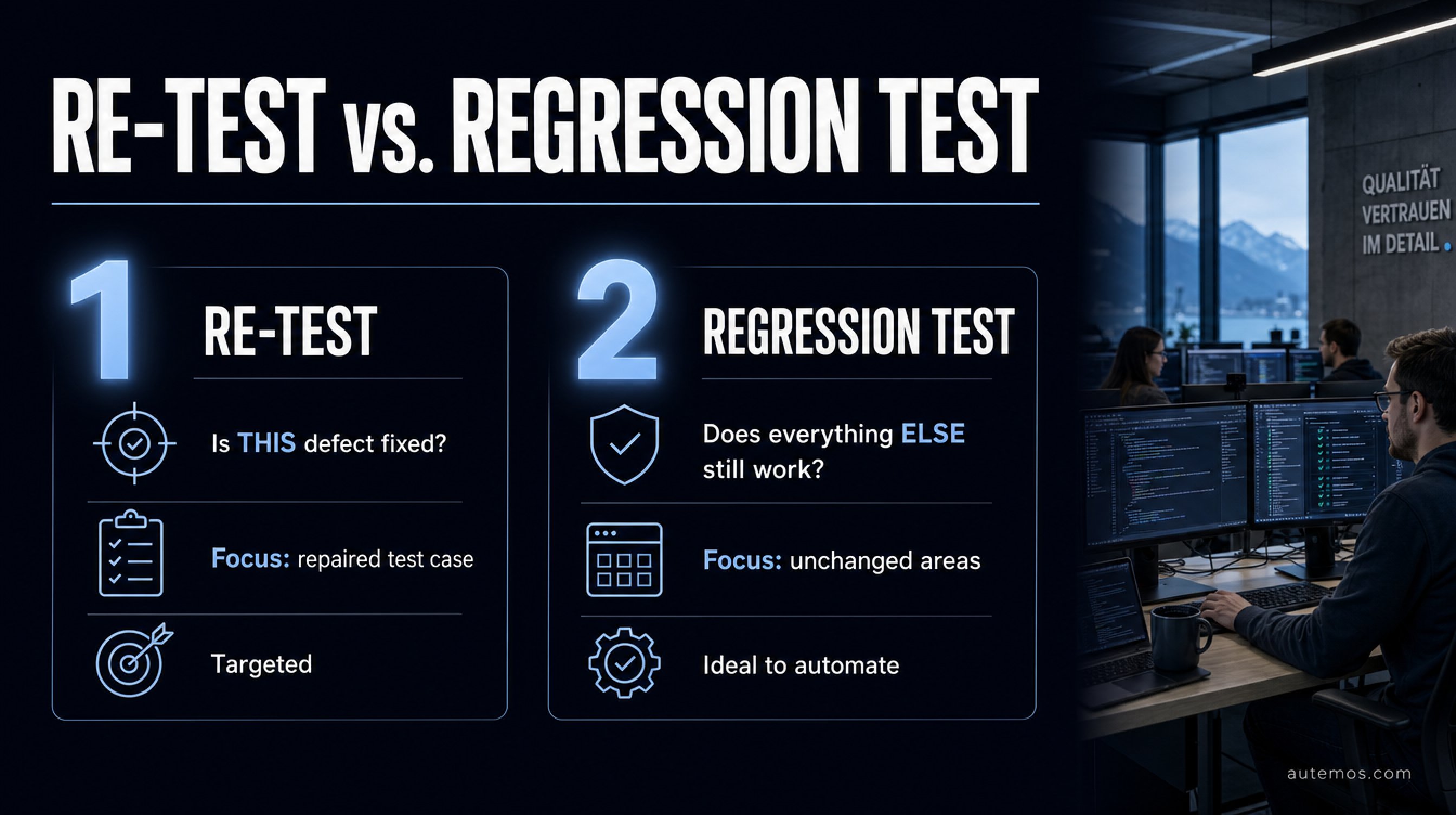
Figure 1: Re-test versus regression test – two clearly separate ISTQB activities.
What is regression testing?
Regression testing is the re-testing of a previously tested program after a modification, with the goal of catching unintended side effects. Per the ISTQB Glossary, it is the re-testing of a previously tested program or partial functionality after a modification, to ensure that no new defects were introduced and no previously masked defects were uncovered (ISTQB Glossary, 2024). In short: you are not testing the new code—you are testing the old code.
The decisive factor is reach. A code change in one place can break behaviour somewhere entirely different, via shared modules, database schemas or interfaces. A solid regression test therefore covers exactly those areas that might be affected indirectly—not just the parts you obviously changed.
In safety-critical domains such as banking, this protection is not optional. A faulty transaction routine or a broken compliance report can carry regulatory consequences. Here regression testing is part of the release gate, providing traceable evidence that existing functionality still works correctly.
Re-test vs. regression test: the ISTQB distinction
A re-test and a regression test answer two different questions. A re-test (confirmation testing) confirms *one* specific fix: you rerun the failed test case to check whether the bug is resolved. A regression test, by contrast, hunts for *unintended* side effects elsewhere.
Criterion | Re-test (confirmation) | Regression test |
|---|---|---|
Question | Is *this* defect fixed? | Does everything *else* still work? |
Focus | The repaired test case | Already-tested, unchanged areas |
Trigger | One specific fix | Any modification to the system |
Automation | Targeted | Highly repetitive, ideal to automate |
In practice they follow one another:
The re-test confirms that the specific fix works.
The regression test ensures the fix did not damage anything else.
When do you run a regression test?

Figure 2: Six typical triggers that fire a regression run.
A regression test is triggered whenever the system changes—and in modern pipelines that happens almost constantly. Automation measurably improves the outcomes: according to the World Quality Report 2024-25, test automation increased test coverage at 53% of organisations and led to faster releases at 51% (Capgemini, 2024).
Typical triggers for a regression run:
New features that touch existing code
Bug fixes whose side effects are unclear
Refactoring with no intended behaviour change
Configuration, environment or dependency changes
Before every release as a sign-off gate
In CI/CD after every merge into the main branch
That last point fundamentally changes the nature of the test. If you merge several times a day, you cannot check manually each time. An automated regression run that fires on every pull request becomes a safety net—but only if it is reliable and does not collapse under unstable tests.
What types of regression tests exist?
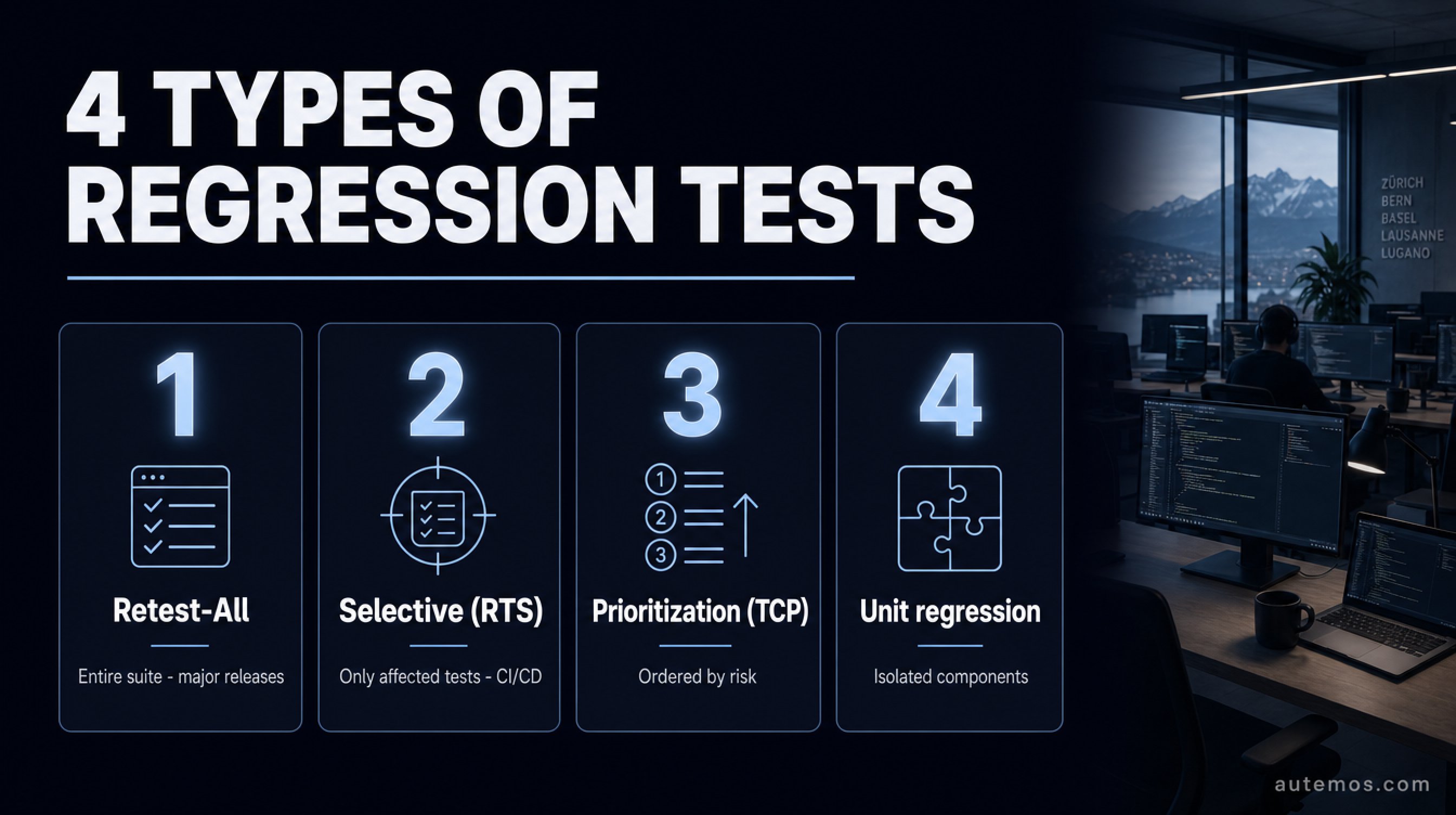
Figure 3: The four regression test types between completeness and speed.
There are four common types of regression test: retest-all, selective regression (RTS), test case prioritization (TCP), and the unit regression test. Not every type covers everything, because as a suite grows, running all tests on every change becomes uneconomical. These strategies trade completeness against speed; the choice depends on risk, runtime and the stability of the suite.
Type | What runs | Strength | Use |
|---|---|---|---|
Retest-All | The entire suite | Maximum safety | Major releases, high risk |
Selective (RTS) | Only tests affected by the change | Fast, resource-light | Frequent CI/CD runs |
Test Case Prioritization (TCP) | Tests ordered by risk first | Finds critical defects early | Tight time windows |
Unit regression test | Isolated component tests | Fastest feedback | Right after commit |
Sources on the types: Tricentis, Ranorex, aqua-cloud (tier 2–3, 2024).
Risk-based prioritization in CI/CD
Regression Test Selection (RTS) and Test Case Prioritization (TCP) are the practical answer to long runtimes. Instead of blindly running everything, an impact analysis determines which tests a change affects and prioritises them by business risk. In a banking pipeline, payment and authentication tests run first.
The effect is twofold: critical defects surface earlier, and developers get faster feedback. A full retest-all suite still makes sense—nightly or before a release, when time is less scarce than on every individual merge.
Why is regression testing the ideal automation candidate?
No test type suits automation better than regression testing, and the numbers back it up: around 45% of QA teams automate it before any other test type (Katalon, 2025). The reason lies in the nature of the task: the same checks, hundreds of times, with minimal variance per run.
That very repetition makes manual regression testing expensive and error-prone. People tire, skip steps and miss subtle deviations. A machine checks the thousandth run as thoroughly as the first. The return on investment is therefore higher here than for almost any other test type.
Then there is the time factor in CI/CD. A manual regression pass that takes hours blocks the entire pipeline. Automated suites run in parallel, overnight or on every merge—and return results before the next commit lands. That is the real lever behind the 51% faster releases from the World Quality Report.
What is the biggest problem with automated regression tests?

Figure 4: Flaky tests – the biggest maintenance problem of automated regression tests (Gruber 2022, Parry 2021).
The biggest problem is maintenance—specifically, unstable and brittle tests. Research shows that 59% of developers encounter flaky tests at least monthly, and 23% rate them a serious problem; according to Gruber et al., flaky tests are „a common and serious problem" (Gruber et al., 2022). Such tests pass sometimes and fail other times, without any code change.
A widely cited study of Google's test base found that around 16% of tests showed flaky behaviour, and 84% of pass-to-fail transitions stemmed from flakiness rather than genuine defects (Parry et al., ACM TOSEM, 2021). This research is a few years old, but the underlying problem remains entirely current.
Brittle tests usually break at the surface: a changed UI, a renamed DOM element or a shifted locator makes a technically correct test fail. The damage is twofold. First, the rework costs time that should go into new tests. Second—and worse—every false alarm erodes trust in the safety net. Teams that habitually ignore red builds eventually miss the real defect too.
How do AI and self-healing solve the maintenance problem?
AI and self-healing solve the maintenance problem by repairing broken element references automatically whenever the UI changes—the test keeps running instead of turning red. The market shows this approach has momentum: 29% of organisations have fully integrated GenAI into test automation, and a further 42% are piloting it (Capgemini WQR, 2024).
The mechanism works in three steps:
The system captures several characteristics of an element instead of binding it rigidly to a single attribute.
If one of those characteristics changes, it identifies the element via the others.
It updates the locator reference automatically, and the test keeps running.
In customer projects we observe that this mechanism catches the bulk of surface-driven test failures—though we will not promise a blanket percentage here, because the effect depends heavily on application and suite.
A visual recorder additionally speeds up suite-building by recording workflows as tests rather than coding them. Combined with cross-stack coverage across web, mobile, API and desktop, you can build and maintain a regression suite that keeps pace with modern release cycles.
Synthetic test data as a complementary lever
Another AI-driven trend concerns the data side. The use of synthetic test data rose from 14% in 2024 to 25% in 2025 according to the World Quality Report (Capgemini, 2025). In banking especially, where real customer data is sensitive under data-protection law, synthetic data enables realistic regression runs without compliance risk.
What does this mean for DACH banks and compliance?
For regulated firms, regression testing is more than quality assurance—it is part of the audit trail. Poor software quality cost around USD 2.41 trillion in the US alone (CISQ, 2022). In a BaFin-regulated environment, regulatory risk adds to the cost side.
Banks must be able to prove at every release that critical functions—transaction processing, interest calculation, reporting—still work correctly after a change. An automated regression run provides exactly this evidence: reproducible, timestamped and versioned. Manual tests can rarely deliver this with the required completeness.
That makes suite stability a compliance matter. A suite that regularly fails on flaky tests produces no reliable audit trail. Here self-healing mechanisms and risk-based prioritization are not a luxury but the precondition for automated regression tests to count as dependable evidence at all.
FAQ
What is the difference between a re-test and a regression test?
A re-test confirms that a specific defect is fixed—you rerun the failed test case. A regression test, by contrast, checks whether the fix caused unintended side effects elsewhere. Per ISTQB these are two clearly separate activities that follow one another in practice (ISTQB Glossary, 2024).
How often should you run regression tests?
As often as the system changes. In modern CI/CD pipelines that means a run after every merge, plus full runs before each release. Automation is what makes this frequency practical—it raised release speed at 51% of organisations (Capgemini, 2024).
What are flaky tests and why are they a problem?
Flaky tests return green sometimes and red other times with unchanged code. Research shows 59% of developers hit them at least monthly (Gruber et al., 2022). They cost maintenance time and erode trust in the suite—teams then start ignoring red builds reflexively.
Is it true that a production defect costs 100× more?
The often-quoted "100×" rule is not well substantiated and should be treated with caution. What is undisputed is that poor software quality causes enormous costs—around USD 2.41 trillion in the US in 2022 alone (CISQ, 2022). Testing earlier demonstrably lowers those costs.
Should you always run the entire test suite?
No. For large suites, retest-all on every merge is uneconomical. Regression Test Selection runs only affected tests; Test Case Prioritization orders by risk. Full runs remain sensible for major releases, while frequent CI/CD runs use the selective strategy for fast feedback.
Conclusion
Regression testing is the safety net beneath every software change—and the first candidate for automation, as roughly 45% of QA teams confirm (Katalon, 2025). The decisive question is not whether but how. A suite that collapses under unstable tests loses its value; one that stays stable through self-healing locators and risk-based prioritization becomes a dependable audit trail—especially for DACH banks under BaFin oversight. Read on in our overview of software testing types, learn how to reduce test maintenance with AI, and explore the concept of self-healing locators. For how the smoke test fits in, see our sibling article. Want to stabilise your regression suite? Talk to our team.