·
12 min
Continuous Testing: A Guide to Testing in the CI/CD Pipeline

Roman Kirchmeier - Autemos

Continuous testing is the practice of running automated tests on every code change across the CI/CD pipeline, from commit to deployment. The goal is fast feedback on whether a change is ready to release. Test automation in the pipeline gives, in DORA's words, "quick feedback for developers, a short lead time from check-in to release, and a low error rate in production" (DORA, 2024). For QA leads and test architects at banks and insurers, this safety net decides whether frequent releases stay manageable. This guide explains how continuous testing works, why it matters, and how teams adopt it step by step.
In short: Continuous testing runs automated tests on every change in the CI/CD pipeline and reports quality problems in minutes rather than weeks. Poor software quality cost the US economy an estimated $2.41 trillion in 2022 (CISQ, 2022). Early, continuous testing lowers that risk and shortens lead time to release.
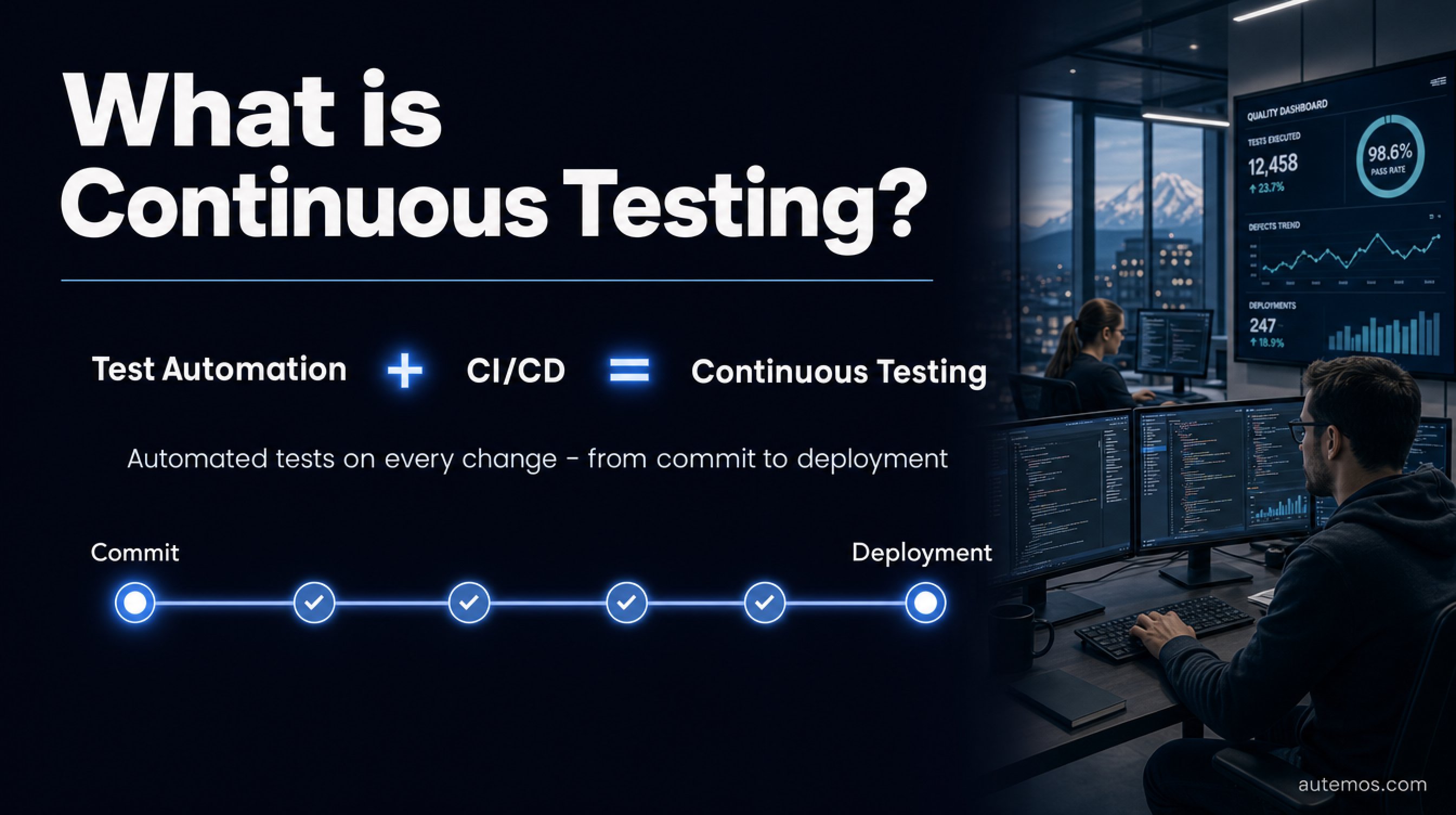
Figure 1: Continuous testing joins test automation and CI/CD across the whole pipeline.
What is continuous testing?
Continuous testing is a testing practice that embeds automated checks into every stage of the CI/CD pipeline, so every code change is checked at once for regressions, integration faults, and non-functional risks. The term names the practice, not a single tool.
Three terms often get mixed up. Test automation means individual scripted tests that run without manual work. CI/CD is the delivery mechanism that builds, integrates, and ships code. Continuous testing joins the two: the right tests run at the right point of every pipeline run and give a clear pass-or-fail signal.
In continuous delivery pipelines, every change triggers a build that creates packages and runs unit tests. Past that first gate, wide-ranging automated acceptance tests and non-functional checks such as performance measurement and vulnerability scans run against the auto-deployed software (DORA, 2024). Continuous testing keeps that net stretched across the whole path.
The difference from classic test phases is timing. In the old model, a separate QA team tested at the end of a sprint or before a release. Continuous testing spreads the same test work across many small runs that fire on each commit. Faults surface where they start, not weeks later.
Why does continuous testing matter?

Figure 2: Cost of poor software quality in the US in 2022 (source: CISQ 2022).
Continuous testing matters since late defects are expensive and frequent releases turn risky without an automated safety net. Poor software quality cost the US economy an estimated $2.41 trillion in 2022, plus accumulated technical debt of roughly $1.52 trillion (CISQ, 2022).
One widely repeated figure gets this wrong: defects supposedly cost 100 times more in production, credited to the "IBM Systems Sciences Institute." No verifiable primary study backs that 1:100 number (The Register, 2021). The defensible claim stays directional: the later a defect surfaces, the more it costs. A single universal multiplier has no empirical support.
The payoff shows up in delivery performance. DORA links continuous testing to shorter lead time, greater stability, and a lower production error rate (DORA, 2024). The share of teams in the highest-performing cluster shifts each year and sat at roughly 22 percent in 2024, down from about 31 percent the year before (DORA, 2024).
The current AI surge needs this foundation too. DORA found in 2024 that a 25 percent rise in AI adoption came with an estimated 1.5 percent lower throughput and 7.2 percent lower delivery stability. The authors' read: the gains do not appear without fundamentals such as small batch sizes and reliable testing (DORA, 2024). Teams that generate faster need a tighter test net.
How does continuous testing work in the CI/CD pipeline?
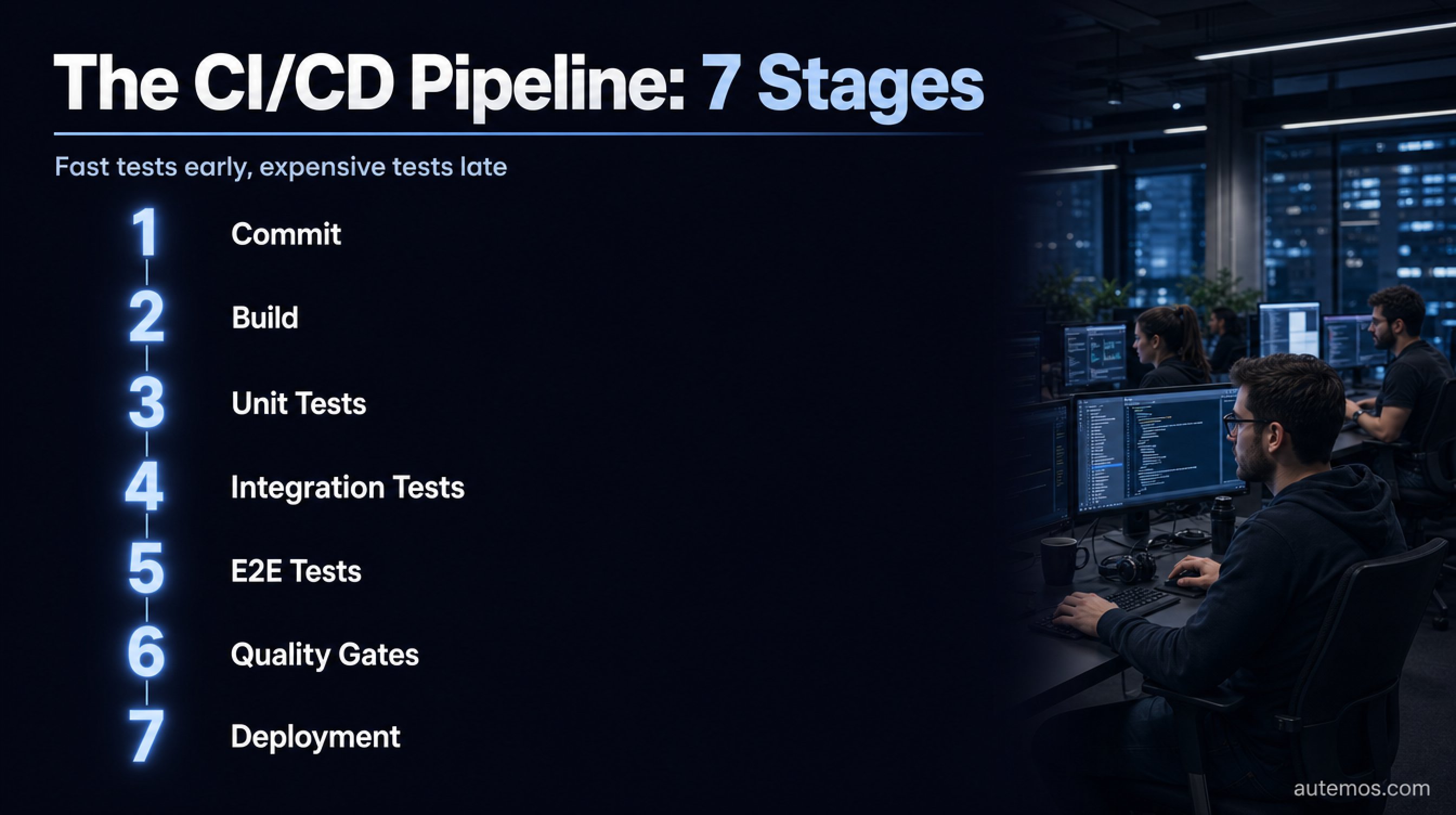
Figure 3: The seven stages of the CI/CD pipeline, fast tests early and expensive tests late.
Continuous testing works as a staged sequence of test gates that a change must pass from commit to deployment, with fast tests running early and expensive tests later. Each stage can stop the change before it reaches the next one.
A typical run follows these steps:
Commit: a developer pushes a change, and the pipeline starts automatically.
Build: the pipeline builds the packages and stops at once on compile errors.
Unit tests: fast unit tests check individual functions in seconds to a few minutes.
Integration tests: modules and interfaces run against real dependencies.
E2E tests: they check critical user flows against a deployed version.
Quality gates: automated thresholds decide on release or stop.
Deployment: once a change passes every gate, it ships or waits for release sign-off.
The order follows a simple rule: cheap and fast first, expensive and thorough later. Unit tests catch most faults in minutes and keep the feedback loop short. Slow E2E tests run later, so a trivial typo does not surface only after half an hour.
Where the boundaries between stages sit depends on the test pyramid: many fast unit tests at the bottom, few slow E2E tests at the top. Teams that ignore this split build a slow, brittle pipeline. Our article on the test pyramid as the base of test automation covers the details.
Shift-left and shift-right: when does testing happen?
Shift-left and shift-right move tests to both ends of the pipeline: shift-left pulls checks closer to the commit, and shift-right checks behavior in production. Continuous testing combines both directions into one continuous safety net.
The term shift-left traces back to Larry Smith, who coined it in Dr. Dobb's Journal in 2001 and used it to tie QA and development closer together (Shift-left testing, 2001). In practice that means unit tests, static analysis, and contract tests run as the code takes shape, not afterward.
Shift-right adds checks after the release: monitoring, canary deployments, and observation of real user load. The two directions work together, since a fault that no pre-deployment test caught should surface early and under control in production.
How teams put early testing into practice, and which mistakes come up often, is covered in the spoke on shift-left testing in practice. It walks through the concrete practices, from dev-owned tests to contract tests.
How do quality gates keep quality in check?
Quality gates keep quality in check by placing automated pass-or-fail thresholds into the pipeline, where a change must meet measurable conditions before it moves on. They make release decisions repeatable rather than a matter of gut feel.
SonarQube defines the term clearly:
"A quality gate consists of a set of conditions against which the code is measured during analysis." And it answers "one question: is my project ready for release?" (SonarQube, 2024)
Typical criteria are coverage on new code, a minimum pass rate, zero new critical findings from static analysis, and a performance or security budget. A sensible gate measures new code strictly and does not force an unrealistic 100 percent overall coverage that only inflates a metric.
In regulated sectors, every gate produces evidence at the same time: who passed which check and when is documented automatically and stays auditable. Which criteria actually help, and which give false comfort, is explored in the article on quality gates in the CI/CD pipeline.
How does parallel test execution speed up the pipeline?
Parallel test execution speeds up the pipeline by splitting a test suite into independent parts and running them at once across several workers, rather than one test after another. The suite can grow without runtime rising at the same rate.
Playwright states the idea plainly: "The whole purpose is to divide your tests to speed up test runtime." Splitting a suite into 4 shards across 4 parallel jobs returns results roughly four times faster (Playwright, 2024).
The price is test isolation. Parallel tests must share no common state, or flaky failures appear that never showed up in sequence. The first large-scale study of flaky tests named async wait, concurrency, and test-order dependency as the leading root causes (Luo et al., FSE, 2014).
Past a certain point, more parallelism buys almost no extra time yet keeps costing infrastructure. How teams find the right split and keep tests stable is shown in the article on parallel test execution.
How do teams integrate tests into CI/CD tools?
Teams integrate tests by tying test runs to pipeline events: a push, pull request, schedule, or event fires the matching test jobs on isolated runners. The three common tools are GitHub Actions, GitLab CI, and Jenkins.
The execution model differs in detail. GitLab describes it this way: "Stages run in sequence, while the jobs in a stage run in parallel." (GitLab, 2024). GitHub Actions starts workflows on events such as push, pull_request, or schedule and orders jobs by a dependency graph. Jenkins records test results in a post step and marks builds with failing tests as unstable.
A recurring problem is the glue work between the test tool and the pipeline. Autemos uses native integration here: bidirectional sync of test cases and executions with GitLab, GitHub Actions, and Jenkins, plus scheduled or event-driven runs and results as an Autemos or Allure report. In client projects we see this direct coupling remove manual scripts. How that runs in detail is shown by the AI Recorder with CI/CD execution.
Which triggers, stages, and reporting options each tool offers is compared in the spoke on test automation in CI/CD.
Maturity: how do teams adopt continuous testing?

Figure 4: Five maturity stages of continuous testing, from manual testing to a continuous safety net.
Teams adopt continuous testing step by step, growing from manual tests at sprint end to event-driven runs across every platform, shortening the feedback loop at each stage. The jump rarely happens in one move.
The stages below map the typical path:
Stage | Trait | Feedback timing |
|---|---|---|
1 Manual | Tests run by hand after the build, often at sprint end | Days to weeks |
2 Automated | Unit tests run automatically in CI on every commit | Minutes for unit tests |
3 Integrated | Integration and E2E tests run in the pipeline before merge | Hours per change |
4 Governed | Quality gates and parallel execution stop faulty builds automatically | Minutes, even at large suite size |
5 Continuous | Tests across Web, Mobile, API, and Desktop run event-driven at every stage | Continuous per change |
The most common stumbling block sits between stage 2 and 3. Unit tests in CI are quick to set up, yet stable integration and E2E tests often fail on brittle locators that break after each UI change. Self-healing locators stabilize such tests and cut false failures that block a pipeline.
Teams that want to compare the available tools find guidance in the comparison of test automation tools. Autemos aims at stage 5: Web, Mobile, API, and Desktop in one pipeline, compatible with Playwright, Selenium, and Appium code. The selementrix consultancy reached roughly 70 percent lower license cost with the Selenium Toolkit on one financial-sector project, a consulting outcome and not a product promise.
Frequently asked questions
What is the difference between continuous testing and test automation?
Test automation means individual scripted tests, and continuous testing means the practice of running the right tests on every change through the whole CI/CD pipeline. Automation is the prerequisite; continuous testing is the application across the full delivery path, with staged gates from commit to deployment.
Does continuous testing need 100 percent test coverage?
No, 100 percent coverage is neither needed nor sensible. A quality gate measures new code strictly rather than forcing an unrealistic overall rate (SonarQube, 2024). More important than the raw number is that critical user flows and risk areas are reliably covered.
How fast should a CI pipeline with tests run?
Fast tests should give a signal in minutes, so developers stay in flow. Unit tests run early in seconds to minutes, and slow E2E tests run later. Parallel execution keeps total runtime manageable: 4 shards across 4 jobs return results roughly four times faster (Playwright, 2024).
Is continuous testing suitable for regulated sectors such as banks?
Yes, regulated teams benefit most, since every automated gate produces an auditable record at the same time. DORA reports that even regulated and safety-critical organizations reach elite performance, and the industry is no barrier (DORA, 2024). Repeatable release criteria make audits easier rather than harder.
Does AI-assisted testing replace continuous testing?
No, AI adds to continuous testing without replacing its fundamentals. DORA found in 2024 that a 25 percent rise in AI adoption without solid test coverage came with 7.2 percent lower delivery stability (DORA, 2024). Teams that produce more code faster need a tighter test net.
Conclusion
Continuous testing turns testing from a phase at the end into a continuous signal across the whole CI/CD pipeline. The economic stakes are high: poor software quality cost the US economy an estimated $2.41 trillion in 2022 (CISQ, 2022). The path runs through staged tests, shift-left and shift-right, dependable quality gates, parallel execution, and native integration with CI/CD tools. No team jumps to the top maturity stage in one step, yet each stage shortens the feedback loop and lowers risk. If you want to build continuous testing across Web, Mobile, API, and Desktop in one pipeline, talk to the Autemos team about the next concrete step.