·
11 min
Test Automation Tools Compared (2026): How to Choose the Right One

Roman Kirchmeier - Autemos

Choosing the right test automation tool in 2026 comes down to maintenance load, license transparency and audit capability; there is no single best tool for every team. Gartner forecasts that by 2027 roughly 80 % of enterprises will have integrated AI-augmented testing tools into their toolchains, up from about 15 % in early 2023 (Gartner via Katalon, 2025). This comparison sorts the relevant test automation tools: the open-source classics Selenium, Playwright and Cypress, the commercial suites Tricentis, Katalon and Ranorex, plus AI-native approaches. You will learn which selection criteria matter for regulated DACH environments and which tool fits which team.
TL;DR: There is no single best tool for everyone. Open-source frameworks like Playwright win on cost and control, commercial suites like Tricentis on enterprise breadth, AI-native tools on maintenance load. Gartner expects roughly 80 % AI testing-tool adoption by 2027. What decides it: maintenance, license transparency and audit capability.

Figure 1: The three categories of test automation tools at a glance.
What test automation tools are on the market?
Seven tools cover most of the market: three open-source frameworks, three commercial suites and one AI-native category. They differ in language coverage, self-healing, platform breadth and above all in pricing transparency. Tricentis, for one, publishes no prices (Tricentis Pricing, 2025); Katalon does. The table below sums up the core traits.
Tool | Type | Languages | Auto-Wait / Self-Healing | Browser / Platform | License / Price transparency |
|---|---|---|---|---|---|
Selenium | Open source | Java, Python, C#, Ruby, JS | Manual waits, no self-healing | Chrome, Firefox, Safari engine (via drivers) | Free, W3C standard |
Playwright | Open source | JS/TS, Python, Java, .NET | Native auto-wait, no self-healing | Chromium, Firefox, WebKit (bundled) | Free, Microsoft project |
Cypress | Open source | JS/TS | Native auto-wait, no self-healing | Chrome family, Firefox, WebKit (experimental) | Core free, Cypress Cloud paid |
Tricentis Tosca | Commercial | Codeless (model-based) | Vision AI self-healing | 160+ technologies, SAP, Citrix | Quote on request, not public |
Katalon | Commercial | Low-code + Groovy/Java | Self-healing (paid tier) | Web, API, Mobile, Desktop | Public, ~$900–2,500/seat/year |
Ranorex | Commercial | Codeless + C#, VB.NET | Object recognition, no AI self-healing | Windows desktop, Web, Mobile | Quote / third-party listing |
AI-native (e.g. Autemos) | AI-native | Low-code + real Playwright/Appium code | Self-healing with documented heals | Web, Mobile, API, Desktop | Sales-led, OnPrem standard |
The Selenium and Playwright figures come from the official downloads and release pages (Selenium, 2026; Playwright, 2026). A deeper head-to-head sits in our detailed direct comparison of Selenium and Playwright.
Which selection criteria really matter?
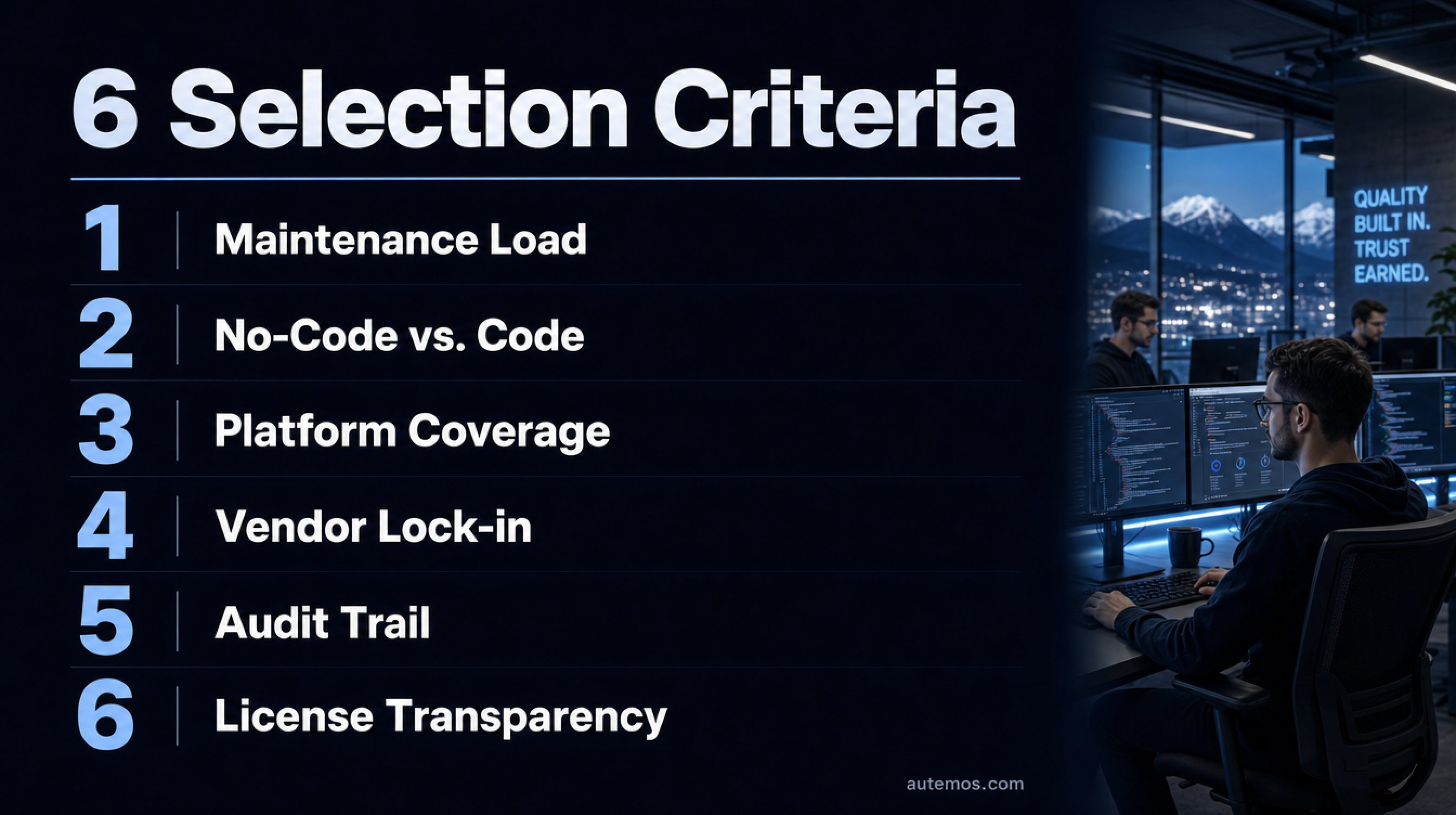
Figure 2: Six selection criteria that decide the tool choice.
Six criteria decide the tool choice, and maintenance load tops the list for most teams. The World Quality Report 2025-26 cites an average 19 % productivity gain from AI in quality engineering, yet a third of firms saw little effect (Capgemini WQR 2025-26, 2025). Check these points concretely:
Maintenance load and self-healing: How much time goes into fixing broken locators? Self-healing cuts that share, provided the heals stay traceable.
No-code vs. code: Does your team need a visual surface, or do your engineers need full code access and versioning in Git?
Browser and platform coverage: Web only, or Mobile, API and Desktop too? Native WebKit support matters for Safari parity.
Vendor lock-in vs. open standards: Does the tool tie you to a proprietary format, or does it export tests that run without the tool?
Compliance and audit trail: In regulated sectors every test run must be auditable. Who changed which test and when has to be documented.
TCO and license transparency: Public prices allow budgeting. Quote-based models like Tricentis make comparison harder.
You weight these criteria differently by context. A startup prioritizes cost and speed; a regulated bank prioritizes audit capability and data residency.
Selenium: the open standard
Selenium is the oldest widely used open-source framework and the only true W3C standard in the field. Its WebDriver became an official W3C Recommendation on 5 June 2018 (W3C WebDriver, 2018). The specification defines it as "a remote control interface that enables introspection and control of user agents". The current version 4.44.0 shipped on 12 May 2026 and covers five language bindings: Java, Python, C#, Ruby and JavaScript (Selenium Downloads, 2026).
The big advantage is vendor neutrality. Tests run on any grid and any cloud that speaks the W3C standard, with no tie to a single supplier. For regulated banks in the DACH region that favour open standards over single-vendor solutions, that is a strong trust signal.
The weakness is maintenance load. Selenium has no built-in auto-wait, so engineers code explicit waits themselves, a primary source of flaky tests. There is no bundled test runner and no native network interception in classic WebDriver. WebDriver BiDi closes these gaps but remains in progress (Selenium BiDi, 2026). Teams that want to move past Selenium will find concrete options in our overview of Selenium alternatives and migration paths.
Playwright: the modern challenger
Playwright is an open-source test framework from Microsoft that, since its announcement in January 2020, has grown into the fastest-rising of the open frameworks. In the State of JS 2024 survey it overtook Cypress for the first time among professional users (3,674 vs. 3,603 responses) (State of JS 2024, 2024). The current version 1.61 ships Chromium 149, Firefox 151 and WebKit 26.5 (Playwright release notes, 2026).
Three traits set Playwright apart from Selenium: a unified cross-browser API across Chromium, Firefox and WebKit, native auto-waiting and a built-in test runner. Trace Viewer, Codegen and native network interception ship in the box. Four language bindings (JS/TS, Python, Java, .NET) are all from Microsoft.
The trade-off is the younger ecosystem and single-vendor governance. Playwright has no native automation of physical mobile devices; it uses browser emulation. For DACH enterprises that value vendor neutrality, the Microsoft tie is a point to weigh. How Playwright fares against Cypress is covered in our direct comparison of Playwright versus Cypress.
Cypress: strong developer experience
Cypress is an open-source testing tool for JavaScript front ends that runs inside the browser, in the same loop as the application under test. This in-process architecture gives deep access to app internals but limits multi-tab and multi-origin scenarios (Cypress cross-browser docs, 2026). Cypress supports Chrome browsers, Firefox and WebKit.
Its strength is the developer experience: real-time preview in the browser, time-travel debugging, automatic reloading and a rich GUI runner. Many teams value that low friction when writing and debugging tests.
The limits stem from the same architecture. WebKit support is experimental, not GA, and uses Playwright's WebKit build (Cypress launching browsers, 2026). OAuth flows across several windows or domains need workarounds. Cypress supports JavaScript and TypeScript only, no other languages. Parallelization in CI runs mainly through the paid Cypress Cloud. For pure front-end teams on a JS stack, Cypress stays a good pick.
Tricentis Tosca: the enterprise suite
Tricentis Tosca is a codeless, model-based enterprise suite and was named a Leader in the first Gartner Magic Quadrant for AI-Augmented Software Testing Tools in 2025 (Tricentis News, 2025). Instead of scripting, testers build reusable modules and assemble test cases visually. Tosca covers over 160 technologies, including SAP, Oracle and Salesforce (Tricentis Tosca, 2025).
The AI features carry their own names: Tosca Copilot as a generative assistant, Vision AI for image-based self-healing and the 2025 Agentic Test Automation that generates test cases from natural language. Tricentis was named a Leader in the Forrester Wave: Autonomous Testing Platforms Q4 2025 as well (Tricentis News, 2025).
The catch is price transparency. Tricentis publishes no prices: the official page offers only a request form (Tricentis Pricing, 2025). Reviewers frequently cite high license costs and a steep learning curve as drawbacks (user reviews on Gartner Peer Insights, 2026). Teams after a more open option will find context in our piece on Tricentis alternatives for regulated enterprises.
Katalon and Ranorex: the commercial alternatives
Katalon and Ranorex are commercial suites with more public pricing than Tricentis. Katalon was listed as a Visionary in the 2025 Gartner Magic Quadrant for AI-Augmented Software Testing Tools (Katalon, 2025). The platform builds on Selenium and Appium and spans Web, API, Mobile and Desktop.
Katalon's prices are public: the True Platform tier at about $900 per seat per year, True Automation with self-healing and AI scripting at about $2,500 per seat per year (Katalon Pricing, 2025). Self-healing sits in the paid tier, not the entry levels. One drawback: the AI features are a later addition layered on a classic Selenium/Appium foundation.
Ranorex comes from Ranorex GmbH in Austria and is well established in the DACH market. The suite is strongest for Windows desktop applications with deep technology support for WinForms, WPF, Qt, SAP and more (Ranorex, 2025). Ranorex offers both codeless record-and-replay and coded automation in C# and VB.NET. Ranorex was not part of the 2025 Gartner MQ.
AI-native tools: Autemos and the market
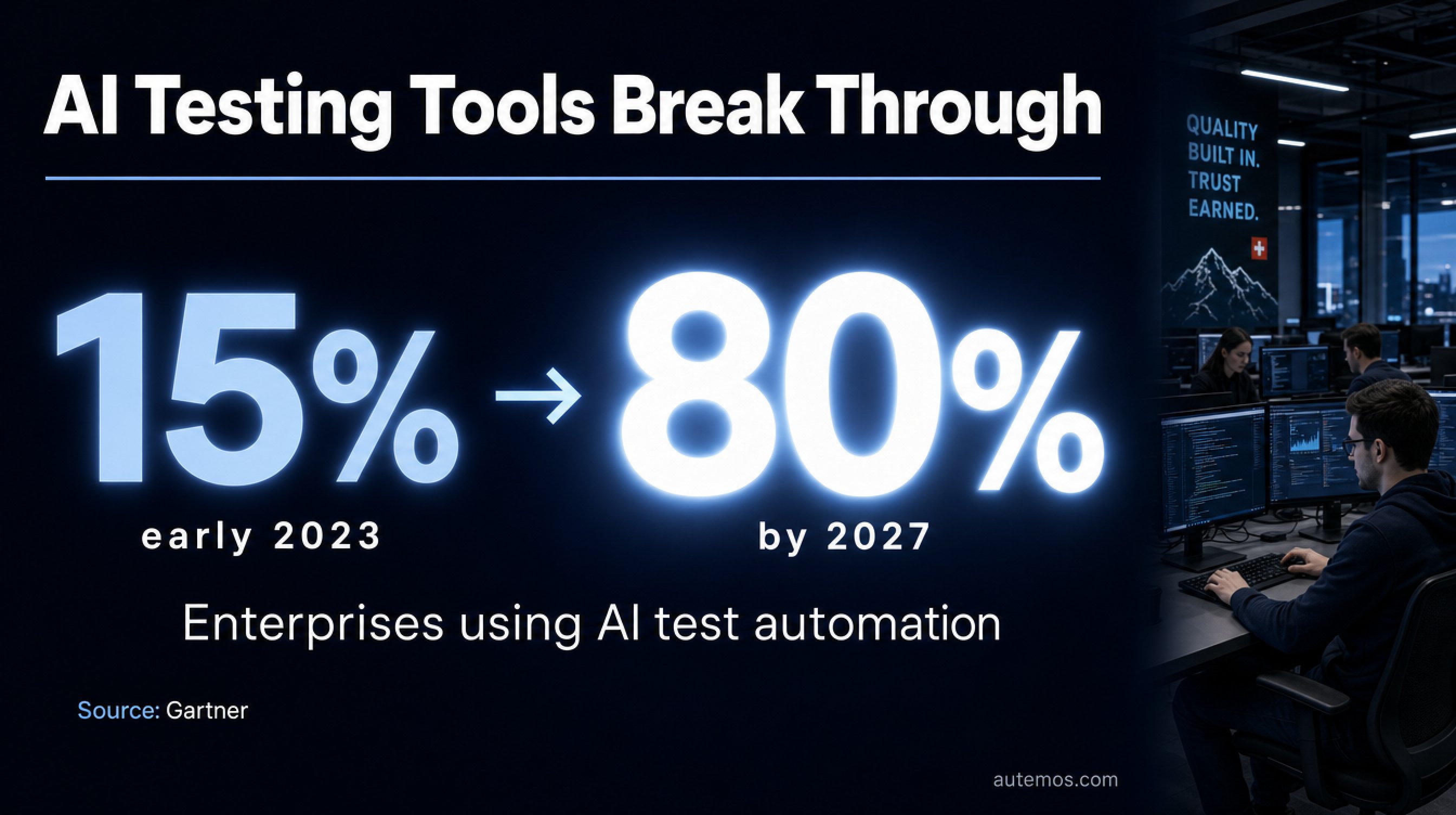
Figure 4: AI testing-tool adoption grows from ~15% (2023) to ~80% (2027), per Gartner.
AI-native tools are built around AI and self-healing from the ground up, rather than adding AI later. The World Quality Report 2025-26 shows that 89 % of organizations pilot or deploy Gen-AI-augmented QE workflows, yet only 15 % have reached enterprise-scale (Capgemini WQR 2025-26, 2025). This category includes tools like mabl, Testim, Functionize, ACCELQ and Applitools (TestGuild, 2026).
Autemos is one of these AI-native options, with a DACH and regulated focus. Four traits set the approach apart from pure black-box tools:
Self-healing with transparency: own stability logic first, an LLM only as a fallback. Every heal is documented, auditable and reversible, no black-box behaviour. Details sit in our piece on self-healing locators and on the self-healing feature page.
No lock-in: Autemos exports real Playwright (Java/TS) and Appium code (Java). Tests keep running outside Autemos, and existing Playwright, Selenium and Appium tests can be imported.
Human-in-the-loop: the AI suggests, the team approves before the run. No unsupervised changes to the test base.
Regulated-ready: OnPrem is standard, not an enterprise surcharge. RBAC, mTLS and a full audit trail are part of the scope.
In consultancy projects with the Selenium Toolkit, selementrix saw roughly 70 % lower license costs and about 80 % less maintenance effort for a financial-sector client. These figures come from consulting engagements, not a product metric. For deeper grounding, read our guide to AI test automation and the explainer on what AI testing actually is.
Open source vs. commercial vs. AI-native: which fits when?

Figure 3: Strengths and matching teams per tool category compared.
The three categories solve different problems, and none is broadly superior. Open source gives full control and zero license cost but demands engineering time for maintenance. Commercial suites bring breadth and support but cost license fees and often tie you to a format. AI-native tools target maintenance load but sit in a younger field.
Category | Strengths | Trade-offs | Fits |
|---|---|---|---|
Open source | Full control, free, no lock-in | Maintenance time, self-integration needed | Engineering-strong teams, CI-heavy stacks |
Commercial | Breadth, support, enterprise features | License cost, often proprietary format | Large programs, SAP-heavy landscapes |
AI-native | Less maintenance via self-healing | Younger field, maturity varies | Teams with high flakiness pain |
In practice many teams combine. An engineering team uses Playwright for critical flows and adds an AI-native tool where maintenance hurts. What counts is that the chosen mix keeps tests in an open format. API tests deserve their own tooling, which we cover in our overview of API testing tools.
How to choose the right tool
The tool choice starts with context: your biggest pain point, your stack and your compliance needs narrow the field more sharply than any feature matrix. The World Quality Report cites a persistent skills gap: 50 % of organizations report a lack of AI/ML expertise (Capgemini WQR 2025-26, 2025). That shapes how much no-code your team needs.
Three team profiles point to three starting points:
JS-heavy web teams with engineering capacity often start with Playwright: modern, free, wide browser coverage.
SAP- or legacy-heavy enterprise programs need commercial suites like Tricentis or Katalon, which cover technologies open source cannot reach.
Teams with high maintenance pain benefit from an AI-native tool with self-healing.
Regulated DACH environments carry extra criteria. The DORA regulation (EU 2022/2554) has required, since 17 January 2025, that financial institutions test their system resilience regularly and auditably (UBS Hainer on DORA, 2025). That favours tools with an audit trail and repeatable automation. GDPR effectively bars real production data in test environments, which makes data masking and OnPrem options important. Swiss banks operate under strict data-residency and auditability expectations that often favour OnPrem over SaaS.
FAQ
What is the best test automation tool in 2026?
There is no single best tool for every case. Playwright leads the open web frameworks and overtook Cypress among professional users for the first time in 2024 (State of JS 2024, 2024). Tricentis dominates the enterprise segment as a Gartner Leader. The right choice depends on stack, team skills and compliance needs.
What does self-healing mean in test automation?
Self-healing adjusts tests automatically when UI elements move or change, without an engineer repairing the locator by hand. Tricentis uses Vision AI for this (Tricentis, 2025); Katalon offers it in the paid tier. What matters is that every heal stays documented and auditable, especially in regulated environments.
What does test automation cost with commercial tools?
It varies widely, and Tricentis publishes no prices: the official page offers only a request form (Tricentis Pricing, 2025). Katalon lists public figures of roughly $900 to $2,500 per seat per year (Katalon Pricing, 2025). Open-source tools like Playwright and Selenium are free but carry maintenance and engineering effort.
Are open-source tools safe for regulated banks?
Yes, provided the surrounding processes meet audit requirements. Selenium's WebDriver is a W3C standard and counts as a trust signal for banks that favour vendor neutrality (W3C WebDriver, 2018). What decides it is audit trail, data residency and OnPrem capability, which you must check independently of the license model.
Should I move from Selenium to a more modern tool?
That depends on maintenance pain. Selenium has no native auto-wait, which causes manually coded waits and flaky tests (Selenium BiDi, 2026). If your team spends a lot of time repairing locators, Playwright or AI-native options are worth a look. Existing Selenium tests can be imported into some tools without starting from zero.
Conclusion
The tool choice in 2026 follows no ranking, it follows your context. Playwright is the strong standard for web teams with engineering capacity, Tricentis the reference for broad enterprise programs, Katalon and Ranorex solid commercial alternatives with clearer prices. AI-native tools target the biggest recurring pain, maintenance load, and pay off where self-healing brings real value. For regulated DACH environments, audit trail, data residency and OnPrem count more than any feature list. Check license transparency and lock-in before you commit. If you want to assess an AI-native approach with open code export and OnPrem for your team, see Autemos in a 30-minute demo.